


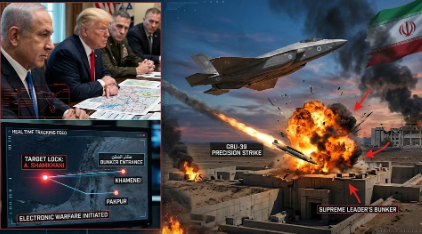
TEHRAN, Iran — In a stunning and unprecedented display of intelligence coordination and military precision, the entire top leadership of the Islamic Republic of Iran, including the Supreme Leader, was eliminated in a single, targeted joint operation by American and Israeli forces. This seismic event has plunged the region into profound uncertainty and raised urgent questions about how Iran’s most secured figures were tracked and defeated within their deepest fortifications.
The Security Dilemma: Tracking a Digital Phantom
The core challenge for Western intelligence has long been how to monitor leadership figures like Ali Khamenei, who famously avoid all digital devices, remaining insulated from conventional signals intelligence. Khamenei was believed to be secure within Iran’s most robust and sophisticated underground bunker network, designed to withstand strategic attacks. His reliance on paper communication and a closed trusted circle was, ironically, his ultimate protection—until now.
Electronic Warfare: The Strategy to Bypass Defenses
According to senior military sources speaking on condition of anonymity, the breakthrough came through an intricate form of “electronic warfare.” Rather than trying to directly access Khamenei’s communication, the operation pivoted to target his closest circle. High-level electronic and signals intelligence (SIGINT) assets began tracking Ali Shamkhani, Khamenei’s National Security Advisor.
While the exact details remain classified, sources close to the operation suggest that a compromised communication signal linked to Shamkhani’s routine security protocols was identified. This allowed intelligence operators to pinpoint his movement. When Shamkhani traveled to the deep underground bunker facility for an emergency meeting, the target-of-opportunity was instantly identified.
The Decisive Airstrike: GBU-39 vs. Concrete
Intelligence data confirmed the precise, simultaneous presence of Khamenei, Shamkhani, and Muhammad Pakpur, the IRGC’s top ground forces commander, within the complex. This information was instantly transmitted to striking aircraft.
Reports indicate that F-35 Fighter Jets and Stealth Drones were deployed, achieving air superiority to execute the highly coordinated mission. The aircraft were equipped with GBU-39 Bunker Buster bombs, powerful concrete-penetrating munitions specially designed to penetrate dozens of feet of reinforced concrete and explode within a target structure.
Eyewitness accounts in the area described several powerful, rapid-succession detonations that rocked the desert facility. Thermal and acoustic data confirmed that multiple GBU-39 bombs successfully hit the bunker entrance and vulnerable structural points, instantly vaporizing the internal leadership command center.
Regional Ripple Effects: Aftermath of the Top Leadership’s Fall
The success of this operation represents a catastrophic failure for Iran’s entire security apparatus. The precision of the intelligence penetration, combined with the devastating effectiveness of modern bunker buster munitions, proves that even the deepest, most insulated installations are vulnerable.
In Tehran, the government announced 40 days of national mourning, while the country struggled to understand the rapid decapitation of its entire senior command. Intelligence services are undoubtedly working to identify the source of the lethal intelligence breach, but the blow to Iranian national confidence and strategic command is already catastrophic.
For the United States and Israel, the successful operation validates years of intense investment in high-end electronic warfare and advanced aerial capabilities. For now, the region waits with bated breath to see how the next generation of Iranian leaders—if they can be found—will react to the new reality where no hideout is truly secure.









Leave a Reply