


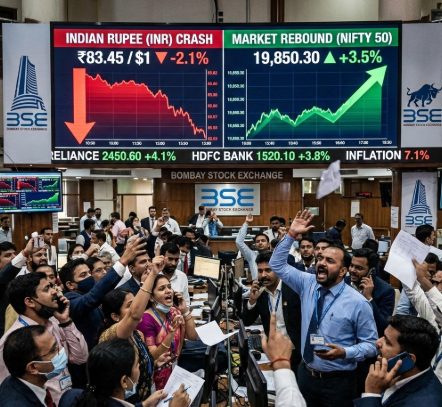
Financial analysis of the economic impact of the Israel-Iran war on India, detailing the record fall of the Rupee and the volatility in the stock markets.
The Conflict Tax on the Rupee
The ongoing military conflict between Israel and Iran has delivered a severe blow to the Indian economy, forcing the Indian Rupee (INR) past the historic psychological barrier of 92 per US Dollar on March 5, 2026. The crash, the sharpest single-day drop in recent history, is directly tied to India’s high vulnerability to energy price fluctuations.
India imports over 80% of its crude oil requirements, much of it sourced from the Persian Gulf. As the conflict intensifies, with reports of sabotage on energy infrastructure and insurance rates for merchant vessels skyrocketing, the threat of supply chain disruption has become a reality. Major international energy firms have begun invoking ‘force majeure’ clauses on natural gas and LNG contracts destined for India, indicating their inability to fulfill deliveries due to the war. This supply squeeze has led to a massive outflow of capital, placing unprecedented pressure on the Rupee.
The Surprise Market Volatility
Despite the currency rout and an initial 1,000-point drop, Indian stock markets showed an astonishing midday reversal. The BSE Sensex and NSE Nifty, after hitting intraday lows, rebounded to trade flat, and in some sectors, higher.
This divergence between the currency and equity markets can be attributed to several factors. Firstly, domestic institutional investors and retail buyers are increasingly viewing market dips caused by external geopolitical shocks as buying opportunities. Secondly, certain sectors, such as defense manufacturing and renewable energy, are experiencing gains due to the expectation of increased government spending in light of global instability.
The Reserve Bank of India (RBI) is expected to intervene aggressively in the coming days to stabilize the Rupee, but the long-term economic outlook remains highly sensitive to the duration and intensity of the West Asia war.








Leave a Reply